A waterborne finish can dry in the cold and still never become a film
As the outdoor painting season closes in much of Europe, a common mistake happens with waterborne finishes on windows, doors, cladding and decking.
The finish goes on in the afternoon. By the next morning it's dry to the touch. By spring it's cracking, chalky, or lifting off with a piece of tape. Often the product was fine. The temperature wasn't.
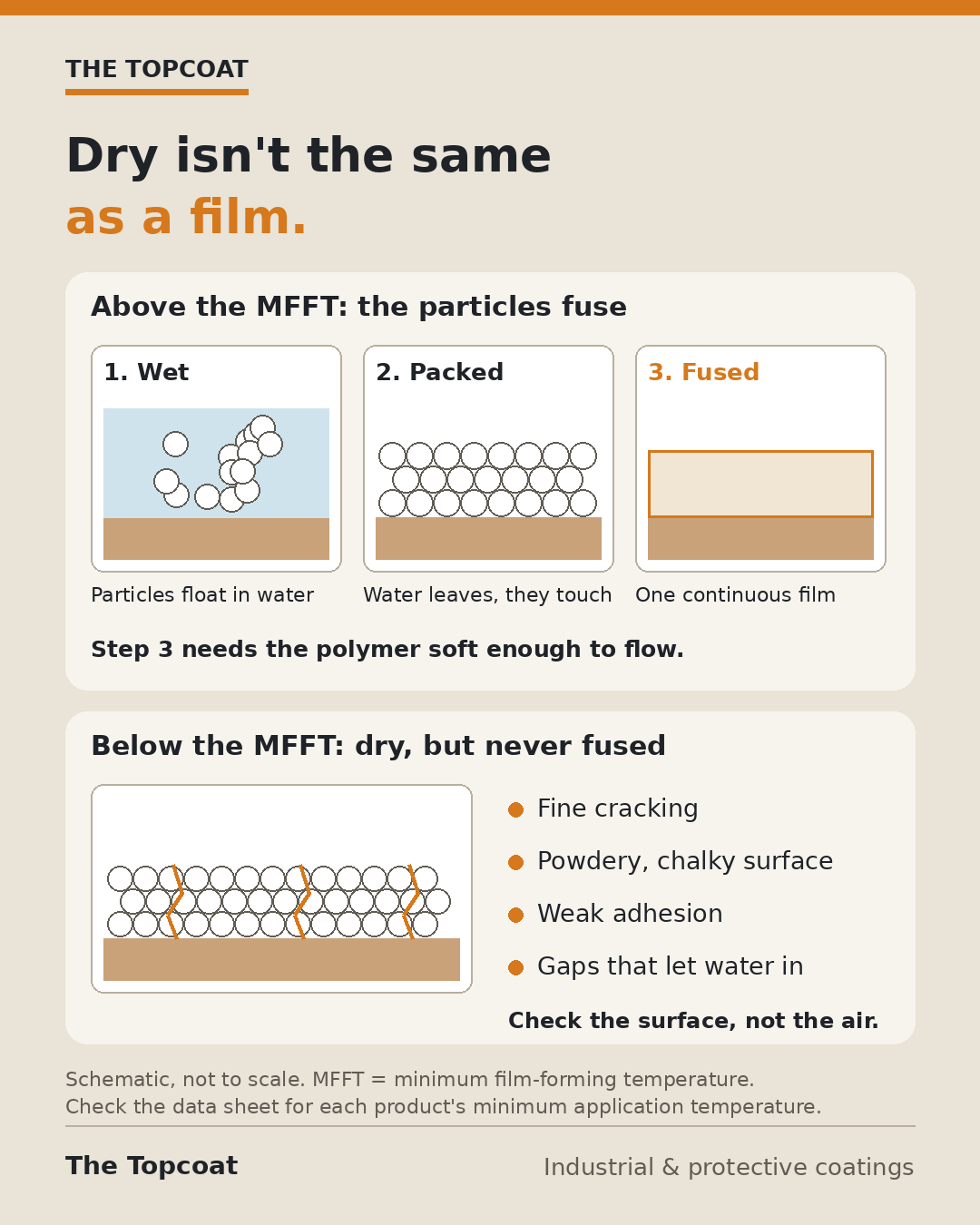
A waterborne finish is not binder dissolved in water. It's a dispersion: tiny polymer particles floating in water, a bit like the fat droplets in milk. As the water evaporates, three things have to happen:
-
The particles crowd together until they touch.
-
They squeeze and deform to close the gaps between them.
-
Polymer chains cross the boundaries between neighbouring particles, so separate particles fuse into one continuous film. This is coalescence.
Step 3 only happens if the polymer is soft enough to flow. Every waterborne product has a minimum film-forming temperature (MFFT). Below it, the particles are too stiff to fuse.
The water still leaves. The surface still looks dry. But what's left is a layer of particles stuck together at their edges, not a film.
The MFFT is closely tied to the binder's glass transition temperature (Tg), the point where the polymer changes from glassy to rubbery. Formulators add coalescing solvents that soften the particles for long enough to fuse, then evaporate.
What a film that never formed properly can show:
-
Fine cracking, sometimes a mud-crack pattern.
-
A powdery or chalky surface.
-
Weak adhesion.
-
Gaps between particles that let water through. On wood, that water drives most of the failures that come later.
Why wood makes this easy to get wrong:
-
What counts is the temperature of the surface, not the air. A shaded board or window frame can be several degrees colder than the forecast.
-
Coalescence takes hours, not minutes. A finish applied on a mild afternoon can drop below its MFFT that evening, before the film has formed.
-
Dew on a film that is still soft adds water just when it should be leaving.
What to do:
-
Read the minimum application temperature on the data sheet, and check whether it means air, surface, or both.
-
Measure the surface, not the air.
-
Start early in the day, so the film gets the warmest hours, and check the overnight forecast too.
-
Give longer drying and recoat times in the cold.
-
If the job has to be done cold, use a product made for low-temperature application.
The same physics applies to waterborne coatings on steel and concrete.
Sources: J. Keddie and A. Routh, "Fundamentals of Latex Film Formation" (Springer).
General information. The project specification and the product data sheet set the requirements for your job.