Steel doesn't burn. So why does it need fire protection?
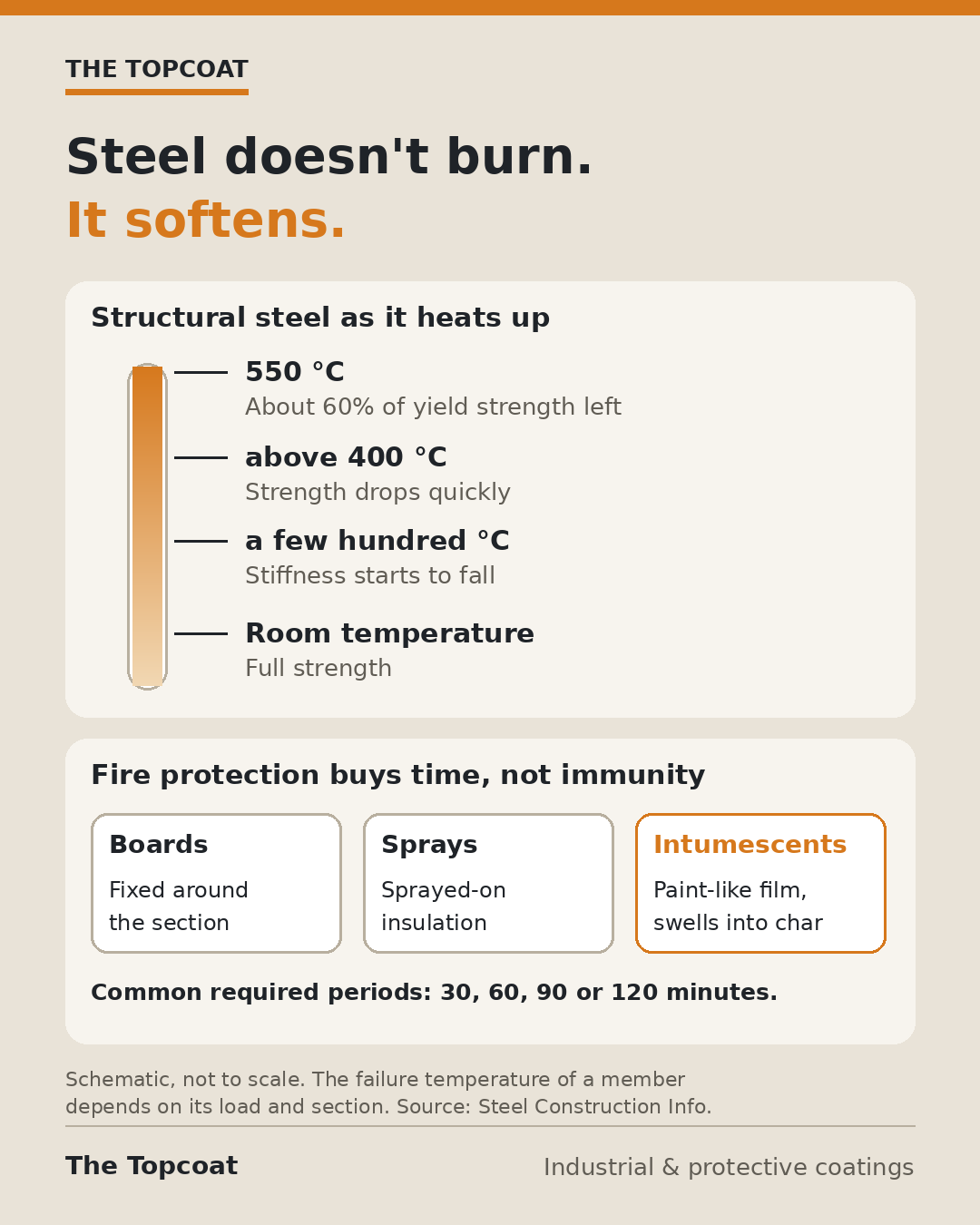
Structural steel is non-combustible. It won't catch fire and it won't feed one. So people are often surprised to see steel beams and columns boxed in with boards or painted with a special coating.
The problem isn't burning. It's softening.
As steel heats up, it first gets less stiff, and above about 400 °C its strength drops quickly. By 550 °C, common hot-rolled structural steels keep only about 60% of their room-temperature yield strength. In the standard fire test, the furnace reaches about 840 °C at 30 minutes and about 945 °C at 60 minutes.
So a beam doesn't have to burn to fail. It only has to get hot enough, while carrying its load, that it can no longer carry it.
How fast does that happen? It depends on the steel section:
-
Small, light sections heat up fast. A small, fully loaded section exposed on all four sides can manage as little as 12 minutes on its own.
-
Large, heavy sections heat up slowly. A very large, lightly loaded section, partly shielded by a concrete floor slab, can reach about 50 minutes without any added protection.
Engineers capture this with the section factor: how much surface the fire can heat, compared with how much steel there is to warm up. More surface per kilo of steel means faster heating.
There is also no single "failure temperature". It depends on how heavily the member is loaded and how the heat spreads through its cross-section. 550 °C is often treated as the failure temperature, but Steel Construction Info calls that "a very conservative assumption".
What fire protection actually does
It doesn't make steel fireproof. It buys time. It slows the heating so the steel stays below its limiting temperature for the period the building needs, often 30, 60, 90 or 120 minutes, depending on the building's height and use. They come from a standard test fire, so they compare systems. They don't predict how long a real fire will last.
There are three main ways to do it:
-
Boards fixed around the section.
-
Sprayed-on insulation.
-
Thin-film intumescent coatings.
The third one is the coatings story. An intumescent looks and behaves like paint on day one. It stays inert at normal temperatures, and in a fire it swells into a thick, charred layer that insulates the steel underneath.
How that char forms, and what can stop it forming properly, is a story for another post.
Sources: Steel Construction Info, "Fire and steel construction" (run by BCSA, Steel for Life and The Steel Construction Institute (SCI)); ISO 834 standard fire curve.
General information. The project specification and the product data sheet set the requirements for your job.