
Why a topcoat peels off in clean sheets
Picture a topcoat peeling off in clean sheets. The coat underneath looks almost untouched. No rust, no blisters. The two layers just never really bonded.
When I see intercoat delamination like that, the first thing I'd check is the overcoating interval.
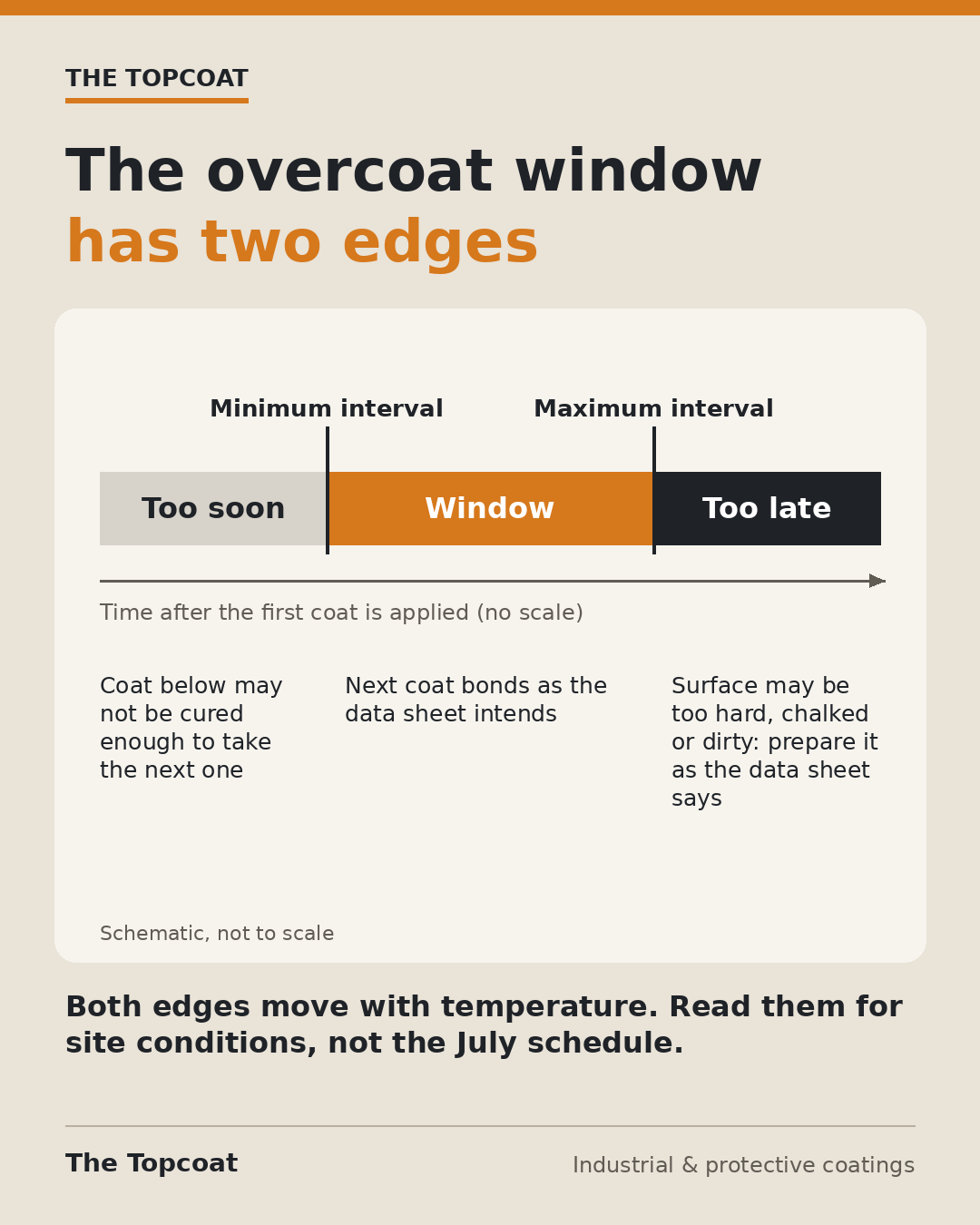
Most two-pack data sheets give a minimum time before the next coat. Many also give a maximum. Both are listed at stated temperatures, and both assume the coat is curing in the conditions the data sheet allows.
Come back too early and the coat below may not be cured enough to take the next one. Solvent from the new coat can soften it, and the system ends up weaker than either layer on its own.
Come back too late and that surface can be too hard, too chalked from sunlight, or simply too dirty for the next coat to grip. Past the maximum, the usual advice is to abrade or solvent-wash the old surface first, and to check with the manufacturer before you do.
Temperature moves both edges. A useful rule of thumb for epoxy curing is that the reaction rate roughly halves for every 10 °C drop. So the minimum you got used to in July can stretch well beyond a shift in November, and the maximum moves with it.
The other usual suspect sits between the coats. Amine blush is the classic one with epoxies that cure in cold, damp air. The curing agent reacts with moisture and carbon dioxide and leaves a deposit on the surface. It can look like a grey haze, white patches or a greasy film, and sometimes you can't see it at all. Paint over it and the next coat struggles to bond.
What makes it worse:
-
surfaces less than 3 °C above the dew point
-
high humidity, especially when it's also cold
-
direct-fired gas or kerosene heaters, which add both CO2 and water vapour
And the frustrating part: blush often doesn't wipe off with water or thinners. Bad cases end up being sanded.
So when a topcoat comes off in sheets, the question isn't only "was it the right paint?" It's "what were the temperature, the humidity and the clock doing between coats?"
How do you keep track of overcoat windows when a job runs across several shifts?
Source: Dinnissen, "Amine blushing and blooming of epoxy binder systems in protective coatings", PCI Magazine.
General information. The project specification and the product data sheet set the requirements for your job.