
Why wood is a hard substrate to coat
Steel is the same in every direction. Wood isn't, and every coating on it has to live with that.
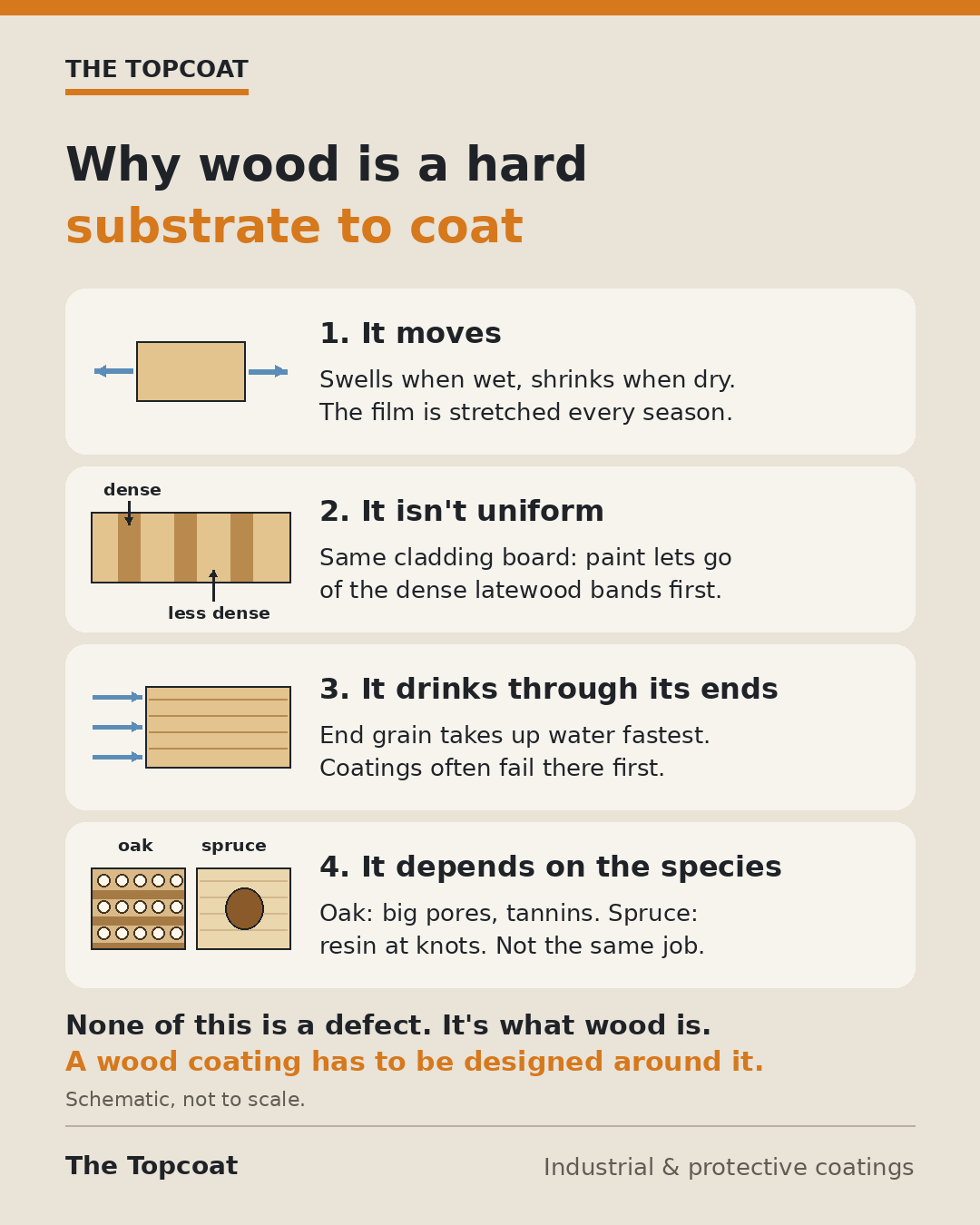
It moves. Wood takes up and gives off moisture with the weather, swelling and shrinking as it goes. A paint film gets stretched and squeezed every season.
It isn't uniform, even within one board. Each growth ring has softer earlywood and denser latewood, and on the same cladding board paint tends to let go of the dense latewood bands first.
It drinks through its ends. End grain takes up water much faster than the face, so cut ends and joints are where coatings tend to fail first.
And it depends on the species. Oak and spruce are both "wood", but they ask very different things of a coating:
-
Oak has large open pores and a lot of tannin. The USDA's guide to finishing wood exteriors calls large-pored hardwoods like oak poorly suited to ordinary house painting unless the pores are filled first. Its tannins can bleed into a waterborne coating while it's still wet, and turn dark where they meet iron from steel fasteners.
-
Spruce is a light softwood with little tannin, but resin is a normal part of the wood, and it likes to bleed out at knots.
So "suitable for wood" on a label doesn't tell you much on its own. The species changes the job.
Which species gives you the most trouble?
General information. The project specification and the product data sheet set the requirements for your job.