Zinc-rich primers, part 2: how much zinc is enough?
Zinc only protects steel if the particles touch each other and the metal. Too little zinc and they don't. Too much and the film falls apart.
How much zinc?
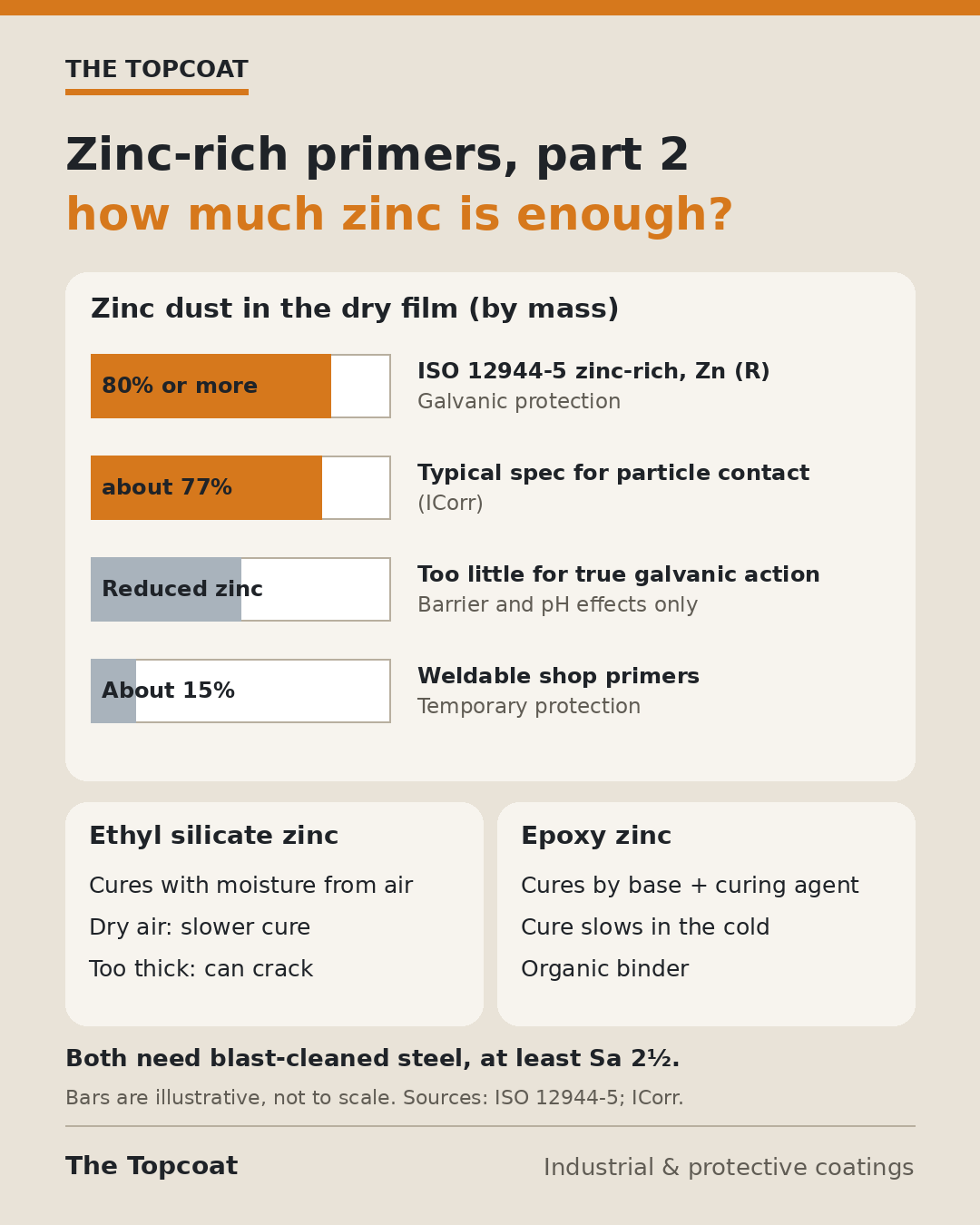
ISO 12944-5 calls a primer zinc-rich at 80% or more zinc dust by mass in the dry film. That figure is also the basis for the durability of the example systems in the standard. Some countries set their national minimum higher.
SSPC-Paint 20 splits it into levels instead. A level of at least 77% is typically what you'd specify when you need the particles in metal-to-metal contact.
Lower down are primers sold as "reduced zinc". They don't have enough zinc for true galvanic protection. They rely on barrier and pH effects instead, and they can work well in milder environments. And the roughly 15% weldable shop primers are only meant to protect steel for a while before fabrication.
Then why not just add more zinc? Because past a point the paint gets hard to apply, the film turns weak and powdery, and adhesion suffers.
One detail I find interesting: measuring metallic zinc in a cured film in the lab has a high margin of error. ISO 12944-5 accepts the manufacturer's declared content based on the formulation instead.
Two families
-
Inorganic zinc, usually ethyl silicate, cures with moisture from the air. Dry air slows the cure, and a film that's too thick can crack, so the thickness limits on the data sheet matter. It takes heat well, but the cured film is porous, which is why the next coat often needs a mist coat to avoid bubbles and pinholes.
-
Organic zinc, usually epoxy, cures like other epoxies, by a reaction between base and curing agent, so cold slows it down instead. It's generally easier to apply, touch up and overcoat.
Two traps in the names: "waterborne" doesn't mean organic (waterborne alkali silicates are inorganic), and a zinc phosphate primer isn't a zinc-rich primer at all. Zinc phosphate is an inhibiting pigment, not sacrificial zinc metal.
What both need
Steel blast-cleaned to at least Sa 2½ with a suitable profile. A zinc primer on poorly prepared steel can't make the contact it depends on. And no ordinary non-conductive primer underneath, unless the system explicitly allows it, for the same reason.
So when a spec says "zinc primer", the useful follow-up questions are: zinc-rich, reduced zinc or zinc phosphate? Silicate or epoxy? And to which standard?
Sources: Institute of Corrosion "Ask the Expert" series, ISO 12944-5, and SSPC-Paint 20 (AMPP). See also Venkatesan Ramanan on organic vs inorganic zinc, Aladdin Mohammed's recent post on zinc in hot water, and Rehan Patel's recent post on a three-coat system with an inorganic zinc primer.
General information. The project specification and the product data sheet set the requirements for your job.